
Ideograms and tattoos
In this article:
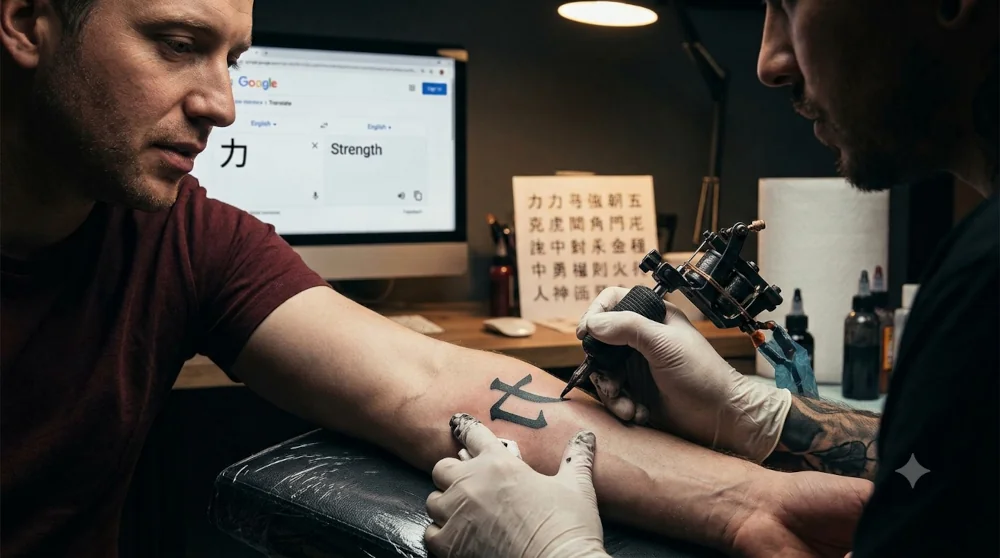
Let's be honest: the danger isn't the ideogram itself—it is usually the source or the person behind the tattoo machine. The internet is packed with legendary "horror stories" of people who got an Oriental character guaranteed to mean one thing, only to find out years later it meant something entirely different. Let's look at some real-world examples of how Chinese and Japanese characters frequently get misused in Western tattoo culture.
1. The real danger behind Asian character tattoos
The vast majority of Western tattoo artists do not read or speak ideograms—such as Hanzi in Chinese or Kanji in Japanese. Because these writing systems are incredibly nuanced, it is remarkably easy to stumble into major design flaws. If an artist treats a complex character as just a simple drawing, you can easily end up with mirrored, upside-down, or incomplete strokes that completely ruin the original meaning.
2. Gibberish ink: When characters get mirrored or flipped
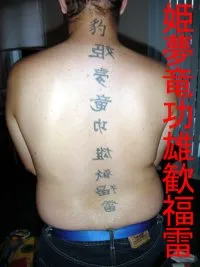
This is how we get what the internet calls "gibberish tattoos"—permanent markings that look like absolute nonsense to a native speaker. For example, look at the photo below: this person wanted a representation of the Chinese zodiac, but ended up with only nine out of the twelve signs, and to make matters worse, every single one of them is completely mirrored.
3. Lost in translation: "Coke", "Idiot", and restaurant menus
The other common type of tattoo failure is even more awkward: the characters are technically inked correctly, but the translation is hilariously wrong. Take the man in the picture below: he proudly carried a massive tattoo on his chest for 26 years, completely convinced it was his name. He had originally trusted a waiter at his favorite local Chinese restaurant to write it down for him. It wasn't until he traveled to Asia decades later that a local gently informed him he had the word "Coke" permanently written across his chest.

In another infamous case, a young man turned 18 and rushed to celebrate his adulthood by getting his name tattooed in Kanji. What he thought was a beautiful transcription of his identity actually turned out to be the exact dictionary definition for the word "idiot."
4. The myth of the Chinese tattoo alphabet
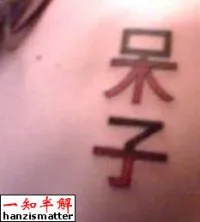
Here is our most important tip: never trust flash sheets or online translation tools that claim to show a "Chinese alphabet." Asian ideograms do not use an alphabet. You cannot translate a Western name by transcribing it letter-by-letter.
While you can find characters that roughly mimic the phonetic syllables of your name, the actual dictionary meanings of those combined characters are often completely unpredictable and can sound incredibly strange to native speakers. Trying to force a phonetic translation without knowing the underlying meaning is a recipe for disaster.
5. How to protect your skin from translation fails
If you are dead-set on getting an ideogram tattoo, you absolutely have to do your homework first. A little bit of deep research ahead of time will save you from a lifetime of bad surprises. Always verify your stencil with multiple, trusted native sources. Today, you can even cross-examine your design using modern AI models, which are getting incredibly accurate at analyzing typography and contextual translations in real time.
Once you have a 100% verified blueprint, your final job is to make sure your tattoo artist places the stencil on your skin correctly—not flipped, mirrored, or upside down. In Asian calligraphy, even a single tiny line or a slightly altered stroke angle can change a beautiful word into total nonsense. Before you sit in the chair, always ask yourself if an ideogram holds enough personal value to be worth the translation risk!
Article Discussion
No comments yet... be the first!